|
Click on each topic or click here to download the full guide in a PDF format file. |
Definitions
A“GREEN” CONCEPT:
The concept of “GREEN”, especially in regards to “CLEANING”, is an overall philosophy, mind set, or objective to move away from synthetic, “toxic” and “hazardous” petrochemical products and towards natural, bio-based ones which provide health and safety benefits to indoor environments while enhancing air quality.
“Petrochemical” means any product derived from “crude oil” or a “petroleum distillate”. “Bio-based” means a product which is derived from a renewable source such as the extracts or oils from fruits, vegetables, plant matter, seeds, or nuts. “GREEN” is NOT just a single or handful of cleaning products which are environmentally responsible. This “GREEN” concept can also apply to the purchasing and use of adhesives, carpeting, copying machine fluids, flooring, furniture, office supplies, paint, stationary supplies... just to name a few... in the workplace.
DEFINING HEALTH:
“Protecting the sanctity of theHumanImmune System”.
The immune system is the body's main system to fight disease. Any defect in the immune system decreases a person's ability to fight infections. Our immune resistance is compromised and lowered by constant exposure to chemical fumes & residues, irritant dust, molds, mildew, & bacteria. However, many factors in the environment -both controllable and uncontrollable- overload the immune system and causes it to breakdown and be less protective. Factors that we can easily control should become our main focus and starting point because the only individuals that are affected by them are us!
BACK TO TOP
The Explanation of “Environmentally “GREEN” Preferable” Cleaning Product Alternatives.
A “GREEN” CONCEPT:
In February 1993, Public Building Services (PBS) of the federal government's General Service Administration (GSA) began the “Cleaning Products Pilot Program”. At that time, the objective was to identify specific “ENVIRONMENTALLY PREFERABLE" (the only viable, legally-binding environmental cleaning chemical term assigned by the federal (and state) governments for products with credentials regarding testing/performance criteria and impact on the environment and health / safety of individuals) cleaning products with reduced health and safety concerns for use in cleaning over 7,000 federal buildings.
Up to that date, most of the publicly available environmental information on products consisted of UNSUBSTANTIATED VENDOR CLAIMS OR “HOME REMEDIES” (with descriptions like “Environmentally Friendly” and “Environmentally-Safe”). PBS officials wished to define and identify “GREEN” cleaning products. Product usage was chosen as the key focus for assessment since it was indicative for the greatest direct health risk from the cleaning products to custodial workers to occupants. Consequently, specific environmental attributes were identified to help assess the environmental preferability of commercially available cleaning products (OR THE INACCURATE DESCRIPTION, “ENVIRONMENTALLY-SAFE”, or, “ENVIRONMENTALLY-FRIENDLY” which really should be described ONLY as “Environmentally-Preferable” as defined by the federal and state government with such programs). These attributes were:
1) Skin irritation potential;
2) Chronic health risks from skin and inhalation exposure;
3) Quickness of ultimate biodegradation;
4) Accumulation Factor (Bio-Concentration Factor of an ingredient to accumulate into the food chain);
5) Percentage of V.O.C. (volatile organic compounds) which increases the potential for off-gassing;
6) Amount of product packaging waste;
7) Presence of ozone depletes;
8) Dispensing Method in regards to potential exposure to concentrated cleaning solutions;
9) Degree of flammability;
10) Amount of cosmetic additives (fragrances and dyes); and
11) Impact on energy requirements.
BACK TO TOP
Cleaning National Parks
Using Environmentally Preferable Janitorial Products at Yellowstone and Grand Teton National Parks:
PROJECT OBJECTIVES
Eliminate or greatly reduce the use of toxic, hazardous and environmentally harmful cleaning chemicals, and potential human health risks.
Reduce the quantity and variety of cleaning products by consolidating and standardizing product purchases.
Choose the safest and “greenest” janitorial products with a proven record in commercial operations.
Involve top management, first line supervisors and janitorial staff in all aspects of this process to ensure long term success.
Source:
Http://www.epa.gov/Region8/conservation_recycling/yellowstone.pdf
Prepared for:
Pollution Prevention Program
U.S. EPA Region 8 (8P-P3T)
999 18th Street, Suite 300
Denver, CO 80202-2466
Prepared by:
Sophia Wakefield and Angele Ferre
S.A.F.E., Consulting for the Earth, Inc.
P.O. Box 4334
Jackson, WY 83001
March, 2000
WHY CHANGE TO ENVIRONMENTALLY PREFERABLE CLEANING PRODUCTS?
Many common cleaning products contain chemicals which, in their pure form, have been shown to have health effects and/or which pose storage and disposal concerns. The potential for a cleaning product to cause problems depends on the concentration and formulation of the ingredients, and on how the product is stored, used and disposed.
While indoor air quality problems can arise from inadequate housekeeping that fails to remove dust or other contaminants, cleaning products themselves produce odors and emit a variety of chemicals that can contribute to poor indoor air quality. The U.S. Environmental Protection Agency's Total Exposure Assessment Methodology (TEAM) studies indicate that while people are using products containing organic chemicals, they can expose themselves and others to high pollutant levels. Elevated concentrations of pollutants can persist in the air, particularly in enclosed spaces and poorly ventilated areas. Selecting cleaning products that minimize these emissions can provide a clean environment while protecting the health of workers and occupants.
There is growing evidence that some chemicals in cleaners are agents that cause asthma or make it worse. In a June, 1999, surveillance of work-related asthma in selected US states - California, Massachusetts, Michigan, and New Jersey - using surveillance guidelines for state health departments showed that in 4.6% of work related asthma cases (51 cases out of 1,101), the putative agent was cleaning materials.
An occupational lung disease bulletin issued by the Massachusetts Department of Public Health in April, 1998, reported that more than 10% of the work-related asthma cases reported list cleaning agents as the suspected asthma agent. These cleaning agents included bleach, chlorine, floor stripper, ammonia, sodium hydroxide, muriatic acid, detergents and disinfectants.
Finally, in the preamble to Occupational Safety and Health Administration's (OSHA) revised Hazard Communication Standard (59 FR page 6151), OSHA cited data from the Consumer Product Safety Commission's (CPSC) National Electronic Injury Surveillance System (NEISS). These data concerned work-related chemical injuries from consumer products where the injury was treated in an emergency room in 1986. The data were provided by emergency rooms to the National Institute for Occupational Safety and Health. According to CPSC, soaps, detergents and “cleaning compounds not classified elsewhere” were cited as responsible for 10, 252 work related emergency room visits. These limited data suggest that users of cleaning products should look for the least toxic product that can do the job in order to minimize potential health and safety risks.
BACK TO TOP

U.S. Department of Interior’s Environmentally - Preferable “Green” Cleaning Chemical Model
http://greeninginterior.doi.gov/sustain/trad.html
Below is a list of environmental attributes set forth by the U.S. Department of Interiors to define an environmentally-preferable cleaning chemical:
-
Must not contain any carcinogens, mutagens, or teratogens designated by federal law. (“Carcinogen” is a cancer-causing agent; “Mutagen” is any agent, such as ultraviolet light, radioactive element, or chemical ingredient which can induce or increase the frequency of mutation in an organism; “Teratogen” is any agent such as a virus, a drug or radiation, that adversely affects and causes malformations of a developing fetus or embryo.)
-
Must be biobased (i.e., utilize biological products or renewable, domestic agricultural [plant, animal, or marine] or forestry materials).
-
Must not contain petrochemical-derived fragrances.
-
Must not contain petro-dyes.
-
Must be biodegradable. (Means 60% to 70% of product’s engredients break down and return to the environment within 28 days, for each organic component above 1% in the ready to use product).
-
Must not contain petroleum distillates.
-
Must not contain chlorinated solvents.
-
Must not contain any ozone-depleting compounds, greenhouse gases, or substances that contribute to photochemical smog and poor indoor air quality.
-
Must have a pH between 4 and 9.
-
Must have a flash point higher than 200º F.
-
Must not be corrosive or irritating to the skin or eyes.
-
VOC levels must meet or be less volatile than the California Code of Regulations maximum allowable VOC levels for appropriate cleaning product categories.
-
Must not be delivered in aerosol cans.
-
Must not contain ingredients included on the “Chesapeake Bay Program's Toxics of Concern list”.
-
Must be dispensed through automatic systems in order to reduce employee contact with the concentrate and to ensure proper dilution ratios.
-
Must not contain any chemicals under “Section 313” of the “Emergency Planning and Community Right-to-Know Act (EPCRA)”.
-
Must not constitute hazardous wastes, as defined in 40 CFR (Code of Federal Regulations) Part 261, when offered for disposal.
-
Must not be toxic to humans or aquatic life.
-
Must not contain endocrine modifiers, alkyl phenyl ethoxylates, dibutyl phthalate, or heavy metals. (e.g., arsenic, lead, cadmium, cobalt, chromium, mercury, nickel, selenium).
-
Must not be combustible.
-
Must not contain more than 0.5 percent by weight of phosphorous.
-
Must not contain persistent or bioaccumulative substances.
BACK TO TOP

EPA's Final Guidance on Environmentally Preferable Purchasing
http://www.epa.gov/oppt/epp/guidance/finalguidancetoc.htm
On September 14, 1998, President Clinton signed Executive Order (EO)13101, entitled “Greening the Government through Waste Prevention, Recycling and Federal Acquisition.” Executive Order 13101 (EO 13101) supersedes EO 12873, Federal Acquisition, Recycling and Waste Prevention, issued on October 20, 1993, but retains a similar requirement for the U.S. Environmental Protection Agency (EPA) to develop guidance to “address environmentally preferable purchasing”.
“Environmentally preferable” is defined in Section 201 of EO 13101 to mean products or services that “have a lesser or reduced effect on human health and the environment when compared with competing products or services that serve the same purpose. This comparison may consider raw materials acquisition, production, manufacturing, packaging, distribution, reuse, operation, maintenance or disposal of the product or service”.
In addition to promoting environmentally preferable purchasing, EO 13101 encourages Executive agencies to purchase bio-based products. (Section 504 (b)). Under the EO, “bio-based product” means “a commercial or industrial product (other than food or feed) that utilizes biological products or renewable domestic agricultural (plant, animal and marine) or forestry materials”.
Guiding Principle 1:
Environment + Price + Performance = Environmentally Preferable Purchasing
Environmental considerations should become part of normal purchasing practice, consistent with such traditional factors as product safety, price, performance, and availability.
The manufacture, use, and disposal of certain products might have adverse impacts on human health and the environment. These impacts impose costs that the purchasing entity, and ultimately, society as a whole, end up paying for in one way or another. For the Federal government, the hazardous or toxic nature of a product or service can result in significant cleanup or liability costs, as well as in less directly quantifiable, but cumulative and persistent environmental damage. Even non-hazardous waste is associated with ever-increasing disposal costs that can be avoided or reduced. Responsible management, beginning with the initial purchase of products and services that minimize environmental burdens, can diminish the Federal government's raw material, operating, maintenance, and disposal costs. In addition, a product or service's environmental preferability can often have positive impacts on its overall performance.
For these reasons, the Federal government's purchasing decisions are no longer confined to considerations of price and functional performance but should include considerations of environmental performance as well. Today agencies can obtain improved environmental attributes not at the expense of, but instead may operate in concert with, other traditional factors like price and functional performance. Those product or service providers who can optimize all these factors will capture and maintain the largest market-share of government customers.
Just like price, performance, and health and safety, environmental factors should be a subject of competition among vendors seeking government contracts.
BACK TO TOP
Interesting Facts
1. Allergic reactions to “Sick” Indoor Environments account for more than 10 million workdays missed by U.S. employees each year.
2. One (1) Sick Day per year X the average U.S. salary X the Total U.S. Working Population = $ 27 Billion Dollars!
3. Allergic reactions to “Sick” Indoor Environments keep 10,000 American children out of school each day. Asthma is the # 1 cause of absenteeism in schools today.
4. A U.C.L.A. study indicates that “adverse health effects have been identified regarding common chemical ingredients found in 222 cleaning products”.
5. According to a latest medical report, conventional cleaning chemicals are “NEUROTOXINS” which may impair a “chemicallysensitive” individual's ability to concentrate and focus at his/her job
6. Forty-one percent (41%) of Health-related “housekeeping” complaints are related to airborne indoor dust and the biological bodily functions of breeding dust mites.
BACK TO TOP

Janitorial Products Pollution Prevention Project
Http://www.wrppn.org/Janitorial/jp4.cfm
Each year about six out of every hundred professional janitors are injured by the chemicals that they use. Burns to the eyes and skin are the most common injuries, followed closely by breathing toxic fumes.
One third of the cleaning chemicals used today have ingredients that can harm you. These ingredients are in products for cleaning glass, restroom fixtures, metal, kitchens, carpets, and hard floors, to name only a few.
Are you cleaning safe?
In 2000, the Environmental Protection Agency; the State of California, and Santa Clara County began the “JANITORIAL PRODUCTS POLLUTION PREVENTION PROJECT” In the San Francisco Bay Area, and continued In Southern California. The findings were disturbing. It was determined by this 18 month study that 41 percent of cleaning chemicals are dangerous, and 6 percent are so dangerous to use such as floor strippers, high-strength degreasers, drain openers, and bowl cleaners that they have no right to be in a building, especially with children.
This study of an evaluation of custodians found that the 27,000 custodians working In Santa Clara County sustained approximately 1,200 Injuries annually 20 percent of which are mostly chemical burns to the eyes or skin. A further review of Just 25 percent of the county's custodians found that they used approx. 400,000 pounds of hazardous materials annually in cleaning, or approximately 60 pounds a year per custodian.
One of the most common petrochemical ingredient used in cleaning products is “2 butoxyethanol”, better known as “butyl cellusolve”. This Ingredient is easily absorbed into the skin and widely used in glass cleaners (such as WINDEX, GLASS PLUS); general purpose cleaners (FANTASTIK, FORMULA 409, SIMPLE GREEN, SPRAY NINE); and carpet spotters (RESOLVE). According to this report, this ingredient,"2-BUTOXYETHANOL", poisons your blood, liver, and kidneys; and may cause pregnancy problems in women over an extended period of time.
What Cleaners Have The Most Risk?
|
Product Type |
Hazardous
Ingredients |
How These Can Harm You |
|
Glass Cleaner
General Purpose Cleaner
Carpet Spot Remover |
A solvent called
“Butoxyethanol" |
Butoxyethanol absorbs through
your skin and poisons your blood,
liver, & kidneys. Wear gloves when
you use cleaners with this ingredient. |
|
Toilet Cleaner |
Hydrochloric Acid
Phosphoric Acid |
These acids are very good for
removing hard water rings, but
they can also blind you in seconds.
Wear your gloves and goggles, or better
yet change to a milder product (one with
Citric Acid - strong lemon juice). |
|
Oven Cleaner
Heavy Duty Degreaser |
Sodium Hydroxide |
Oven cleaner in a spray can -very
convenient, but also very
dangerous. Sodium hydroxide can
blind you, and the vapors can
harm your lungs. Use it with care -
wear gloves & goggles, and
provide lots of fresh air. |
BACK TO TOP
U.S. Environmental Protection Agency
Indoor Air Quality
[This information originates from the EPA publication “The Inside Story - A Guide to Indoor Air Quality”.]
Http://www.epa.gov/iaq/voc.html
Sources of Indoor Air Pollution:
Organic Gases (Volatile Organic Compounds - VOCs)
Organic chemicals are widely used as ingredients in household products. Paints, varnishes, and wax all contain organic solvents, as do many cleaning, disinfecting, cosmetic, degreasing, and hobby products. Fuels are made up of organic chemicals. All of these products can release organic compounds while you are using them, and, to some degree, when they are stored.
EPA's Total Exposure Assessment Methodology (TEAM) studies found levels of about a dozen common organic pollutants to be 2 to 5 times higher inside homes than outside, regardless of whether the homes were located in rural or highly industrial areas. Additional TEAM studies indicate that while people are using products containing organic chemicals, they can expose themselves and others to very high pollutant levels, and elevated concentrations can persist in the air long after the activity is completed.
Sources
Household products including: paints, paint strippers, and other solvents; wood preservatives; aerosol sprays; cleansers and disinfectants; moth repellents and air fresheners; stored fuels and automotive products; hobby supplies; dry-cleaned clothing.
Health Effects
Eye, nose, and throat irritation; headaches, loss of coordination, nausea; damage to liver, kidney, and central nervous system. Some organics can cause cancer in animals; some are suspected or known to cause cancer in humans. Key signs or symptoms associated with exposure to VOCs include conjunctival irritation, nose and throat discomfort, headache, allergic skin reaction, dyspnea, declines in serum cholinesterase levels, nausea, emesis, epistaxis, fatigue, dizziness.
The ability of organic chemicals to cause health effects varies greatly from those that are highly toxic, to those with no known health effect. As with other pollutants, the extent and nature of the health effect will depend on many factors including level of exposure and length of time exposed. Eye and respiratory tract irritation, headaches, dizziness, visual disorders, and memory impairment are among the immediate symptoms that some people have experienced soon after exposure to some organics. At present, not much is known about what health effects occur from the levels of organics usually found in homes. Many organic compounds are known to cause cancer in animals; some are suspected of causing, or are known to cause, cancer in humans.
Levels in Homes
Studies have found that levels of several organics average 2 to 5 times higher indoors than outdoors. During and for several hours immediately after certain activities, such as paint stripping, levels may be 1,000 times background outdoor levels.
BACK TO TOP
Vulnerable Populations to Asthma
Who gets Asthma?
Susceptible populations for asthma include:
Children
- Children 5 to 14 years of age are the most affected by asthma.
- Asthma usually has its onset in early life for the majority of asthmatic children.
- Up to 50 percent of babies experience at least one episode of wheezing during the first few years of life. Two-thirds of these are babies who are born with “small airways” and wheeze with viral infections but otherwise do not seem to develop asthma. The remaining one-third are eventually diagnosed with asthma. These are children who become sensitized to the allergens in their environment early in life.
Ethnic minorities
- Blacks and Latinos / Hispanics also seem to be at the greatest risk.
- African American children, are 3-4 times more likely to be hospitalized than their white counterparts and 4-6 times more likely to die from the disease than their white counterparts.
- Puerto Ricans in the United States suffer from asthma far more frequently than other ethnic groups. One in every five Puerto Rican children (20%) in the United States had asthma in 1982-1984 compared to 4.5% of Mexican-American, 8.8% of Cuban, 9.1% of black and 6.5% of white children.
Good asthma care can be a difficult, labor-intensive, and costly process. Financially hard-pressed families need support and resources to help them manage their disease and avoid using the emergency room as primary care.
BACK TO TOP
Household Products
Many household products contain potentially harmful chemicals. Cleaning products may contain bleach or ammonia which are strong airway irritants. Moth balls contain naphthalene and solid air fresheners often contain formaldehyde. Some of these products release toxins into the air right away; others do so gradually over time. Not only are you exposed to these toxins during use, but they can stay trapped inside your home until they can escape through an open door or window. Vapors can build up undetected and create dangerous levels of pollutants. Health effects from household products include dizziness, allergic reactions and respiratory tract irritation. Some household products may cause cancer.
Avoid aerosol sprays such as air fresheners and furniture polish.
Aerosol particles are small enough to travel deep within the lungs. These particles can carry many toxic chemicals with them. Use pump sprays.
One of the easiest things to change...
The warning is as follows:
WARNING: Store all household products safely away from children.
In case of accidental poisoning contact the Poison Control Center at (800) 764-7661.
©1998 American Lung Association of Southeast Florida.
All rights reserved. Revised 1999.
BACK TO TOP
Plant Bio-Based Chemicals
“Biochemicals”
http://www.carbobydrateecooomy.org/html/biochem.htm
What are Biochemicals?
In industry the term “biochemical” often refers to the category of petrochemicals that are used on agricultural crops. At the Institute for Local Self-Reliance (ILSR), we use the term to refer to chemicals that are produced from plant matter. These biochemicals are derived from renewable resources such as vegetable oils, fiber and grain crops, citrus fruits, nuts and trees. Plant matter-based chemicals such as soy methyl esters, ethyl lactate and grain-derived alcohol are used to produce a variety of industrial products for processing and manufacturing operations. Examples of applications for plant-based chemicals include industrial solvents, equipment lubricants, paints and coatings and plastics.
Biochemicals enhance worker safety
Biochemicals offer a number of advantages for workers. Most importantly, they significantly reduce the health risks related to petrochemicals. Lower levels of health risk mean that less safety training and protective equipment may be required. Working with less hazardous chemicals reduces the stress associated with accidental spills and contaminations that could lead to uncontrolled reactions. A safer work environment also benefits the manufacturer by reducing work-related Injuries or illness related to hazardous chemical exposures. This translates into fewer liability claims and increased productivity.
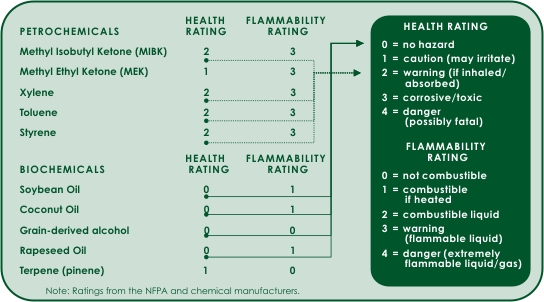
The following table compares the National Fire Protection Association (NFPA) ratings for components of common petrochemical-based products to components of biochemical-based products. Biochemicals exhibit far less health and safety hazards.
Benefits of Biochemicals
Manufacturing Benefits: The private sector benefits from biochemicals in several ways. Biochemicals provide an environmental compliance tool for manufacturers and end-users. Substituting biochemicals can be a permanent solution to regulatory problems by replacing chemicals listed or soon to be listed on the Environmental Protection Agency's (EPA) Toxic Release Inventory (TRI).
Environmental Benefits:
When compared to petrochemical alternatives, the use of biochemicals reduces upstream and downstream pollution. Utilizing plant matter in the manufacture of chemicals decreases the amount of upstream pollution generated from the extraction and processing of crude oil into chemicals. Chemical products derived from plant matter are highly biodegradable and in most cases can be disposed of safely and inexpensively, resulting in less downstream pollution.
Health Benefits:
Businesses can improve the work environment for their employees by using biochemicals and thus reducing health and safety risks. Plant matter-derived chemicals are typically lower in toxicity, flammability and corrosivity than their petrochemical counterparts.
Cost Benefits:
The economics of replacing petrochemicals with biochemicals are increasingly favorable and, when all costs are considered, biochemicals are competitive with petrochemicals. Manufacturers can save money by avoiding costly permits and compliance penalties and through a dramatic reduction in hazardous waste disposal costs. Companies manufacturing or using biochemicals can appeal to "green" consumers, a growing portion of the market.
Biochemical Substitution
Companies interested in reducing environmental and worker safety regulatory pressures are seeking substitutes to petroleum-based manufacturing and operational chemicals. These replacement chemicals are derived from plant matter. Biochemicals can be used in place of petrochemicals at varying stages of product manufacturing to reduce pollution and create a safer work environment.
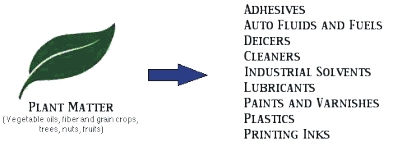
One hundred years ago, most of our society's fuels, construction materials, textiles, inks, paints, and even synthetic fibers and chemicals were made from plant matter. As petroleum flooded the market, plant matter-derived chemicals began to lose ground as the feedstock for industrial products and fuels. By the 1980's, less than 5 percent of our industrial products and fuels came from biological materials.
Today, however, industry is showing signs of shifting away from petroleum and towards plant matter. This is happening as new technologies lower the cost of deriving products from plant matter and environmental regulations raise the cost of extracting, processing, using and disposing of fossil fuel-derived products.
BACK TO TOP
NEW YORK CITY LOCAL LAW
http://www.usgbc.org/Chapters/newyork/docs/pdf/GBbill324.pdf
1
Proposed Int. No. 324-A
By The Speaker (Council Member Miller) and Council Members Gennaro, Brewer, Clarke,
Fidler, Gerson, Gioia, James, Koppell, Liu, Martinez, Nelson, Recchia, Sanders, Stewart,
Weprin, Serrano, Gonzalez, Comrie and Yassky
A LOCAL LAW
To amend the New York city charter, in relation to green building standards for certain
capital projects.
Be it enacted by the Council as follows:
Section 1. Statement of findings and purpose. Few aspects of urban life have more
impact on human health and the environment than building construction and use. Enormous
quantities of resources are used during building construction, renovation and operation, the
production of which has substantial environmental impacts. In addition, many indoor
building materials release hazardous toxins, impairing indoor air quality and reducing
occupant health and productivity.
Buildings also use a tremendous amount of energy. Since much of New York City’s
electricity is produced within the City and buildings use oil or natural gas for their heating
and hot water, energy consumption by buildings translates directly into greater local
pollution, including emissions of sulfur dioxide, nitrogen oxides, particulate matter, carbon
dioxide, and mercury. These pollutants contribute to respiratory disease, heart disease,
smog, acid rain, and climate change. Moreover, as energy demand rises, so does our reliance
on dirty, inefficient power plants and the City and nation’s dependence on foreign oil and
natural gas.
2
Modern architects and engineers can reduce the health and environmental impacts of
buildings by designing “high-performance buildings” or “green buildings.” The United
States Green Building Council, the nation’s foremost coalition of real estate and
environmental organizations working to promote green buildings, has developed a green
building rating system known as LEED (Leadership in Energy and Environmental Design).
Buildings receive LEED certification if their designs score sufficient "points" in five general
design areas including siting, water efficiency, energy and atmosphere, materials and
resources and indoor environmental quality. Thousands of residential and commercial
buildings, ranging from single-family homes to large corporate headquarters, have been
designed and constructed throughout the United States utilizing green building principles.
Significant local examples include 4 Times Square and 20 River Terrace. A recent study
conducted for the State of California concluded that, on average, green buildings show a ten
times return on the investment in green building design. This comprehensive analysis of 33
green buildings revealed an average green cost premium of less than 2%, with only a 0.66%
premium for buildings that achieved the most basic level of LEED certification.
Numerous municipalities, including Atlanta, Austin, Boston, Boulder, Chicago,
Dallas, Los Angeles, Portland, San Diego, San Francisco, San José, and Seattle, have
adopted LEED or have otherwise required that city-owned buildings be built according to
green building criteria. Some localities have created incentive programs for private green
building construction including direct subsides, density bonuses and expedited permitting,
and Boston will soon require private sector buildings over 50,000 square feet to be LEEDcertifiable.
In New York City, numerous governmental bodies have also embraced green
building. The Battery Park City Authority has begun utilizing green building guidelines
3
modeled on LEED for all commercial and residential building construction in Battery Park
City. The Department of Design and Construction has also developed High Performance
Building Guidelines and has begun applying the guidelines for libraries and other facilities.
The New York City Transit Authority has adopted green building guidelines for all new
transit facilities, including the Second Avenue Subway. Moreover, the Lower Manhattan
Development Corporation and the Port Authority of New York and New Jersey have
developed sustainable design guidelines and have designated “environmental planning” as
one of five general requirements for the redevelopment of the World Trade Center site and
surrounding area.
Likewise, many states, such as California, Connecticut, Maryland, Massachusetts,
New Jersey, New York, Pennsylvania, and Rhode Island, have begun utilizing LEED for
state-owned buildings. The State of New York provides tax credits for buildings that meet
defined green building criteria and, under Executive Order 111, state agencies are directed
to reduce energy use and carbon dioxide emissions and to utilize green building principles.
The Council finds that the use of green building criteria will substantially reduce the
City’s electricity consumption, air pollution and water use, as well as improve occupant
health and worker productivity and encourage market transformation. The Council further
finds that reducing overall energy demand through green building techniques will reduce
our dependence on foreign oil and allow new power plants to displace power from less
efficient and dirtier existing plants. Accordingly, the Council declares that it is reasonable
and necessary to employ green building standards in the construction and renovation of cityowned
and city-funded buildings and that these standards be utilized in an orderly and
timely fashion.
4
§2. The New York city charter is amended by adding a new section 224.1, to read
as follows:
§224.1 Green building standards. a. As used in this section the following terms
shall have the following meanings:
(1) The term “capital project” shall mean a capital project as defined in section
210 of this chapter that is paid for in whole or in part from the city treasury.
(2) The term “city agency” shall mean a city, county, borough, or other office,
position, administration, department, division, bureau, board or commission, or a
corporation, institution or agency of government, the expenses of which are paid, in
whole or in part, from the city treasury.
(3) The term “construction work” shall mean any work or operations necessary or
incidental to the erection, demolition, assembling, alteration, installing, or equipping of
any building.
(4) The term “green building standards” shall mean design guidelines, a rating
system or rules for constructing buildings that ensure site planning, water efficiency,
energy efficiency and renewable energy, conservation of materials and resources and
indoor environmental quality.
(5) The term “inflation” shall mean the annual twelve (12) month average of the
consumer price index published by the United States department of labor.
(6) The term “LEED energy and atmosphere credit 1” shall mean the credit point
under LEED for New Construction version 2.1 intended to achieve increased energy
performance.
5
(7) The term "LEED green building rating system" shall mean a version of the
Leadership in Energy and Environmental Design (LEED) building rating system
published by the United States Green Building Council, not less stringent than the
selected green building rating system, including a standard developed by or for the city
consisting of practices and technologies derived from the LEED rating system that are
reasonable and appropriate for building in New York city.
(8) The term “LEED water efficiency credit 3.2” shall mean the credit point
under the LEED for New Construction version 2.1 intended to achieve water use
reduction.
(9) The term “not less stringent” shall mean providing no less net environmental
and health benefits.
(10) The term “rehabilitation work” shall mean any restoration, replacement or
repair of any materials, systems and/or components.
(11) The term “selected green building rating system” shall mean the current and
most appropriate building rating system published by the United States Green Building
Council; provided, however, at the mayor’s discretion, the term “selected green building
rating system” shall mean New Construction version 2.1, Existing Buildings version 2 or
Commercial Interiors version 2, whichever is most appropriate for the project under
United States Green Building Council guidelines.
(12) The term “substantial reconstruction” shall mean a capital project in which
the scope of work includes rehabilitation work in at least two of the three major systems,
electrical, HVAC (heating, ventilating and air conditioning) and plumbing, of a building
and construction work affects at least fifty percent (50%) of the building’s floor area.
6
b. In addition to any other applicable subdivision in this section, any capital project
with an estimated construction cost of two million dollars ($2,000,000) or more involving (i)
the construction of any new building, (ii) any addition to any existing building, or (iii) the
substantial reconstruction of any existing building shall be designed and constructed in a
manner that shall comply with green building standards not less stringent than the standards
prescribed for buildings designed in accordance with the LEED green building rating system
to achieve a LEED silver or higher rating, or with respect to any capital project involving
any building classified in occupancy groups G or H-2 to achieve a LEED certified or higher
rating. If the mayor elects to utilize any green building standards other than the LEED green
building rating system, the mayor shall publish findings demonstrating that such other green
building standards are not less stringent than the standards prescribed for buildings designed
in accordance with the LEED green building rating system to achieve a LEED silver or
higher rating or for any capital project involving any building classified in occupancy
groups G or H-2 to achieve a LEED certified or higher rating. The mayor shall review and
update the green building standards utilized by the city no less often than once every three
years.
c. In addition to any other applicable subdivision in this section, with the
exception of any capital project involving any building classified in occupancy groups G,
any capital project with an estimated construction cost of twelve million dollars
($12,000,000) or more involving (i) the construction of any new building, (ii) any
addition to any existing building, or (iii) the substantial reconstruction of any existing
building shall be designed and constructed to reduce energy cost by a minimum of
twenty-five percent (25%), as determined by the methodology prescribed in LEED
7
energy and atmosphere credit 1 or the New York state energy conservation code,
whichever is more stringent; provided, however, that any such project with an estimated
construction cost of less than thirty million dollars ($30,000,000) shall be designed and
constructed to reduce energy cost by a minimum of twenty percent (20%), as determined
by the methodology prescribed in LEED energy and atmosphere credit 1 or the New
York state energy conservation code, whichever is more stringent. The design agency
shall make investments in energy efficiency that reduce energy cost by an additional five
percent (5%) if it finds that the payback on such investment through savings in energy
cost would not exceed seven years.
d. In addition to any other applicable subdivision in this section, any capital
project involving any building classified in occupancy groups G with an estimated
construction cost of twelve million dollars ($12,000,000) or more involving (i) the
construction of any new building, (ii) any addition to any existing building, or (iii) the
substantial reconstruction of any existing building shall be designed and constructed to
reduce energy cost by a minimum of twenty percent (20%), as determined by the
methodology prescribed in LEED energy and atmosphere credit 1 or the New York state
energy conservation code, whichever is more stringent. The design agency shall make
investments in energy efficiency that reduce energy cost by an additional five percent
(5%) if it finds that the payback on such investment through savings in energy cost would
not exceed seven years; provided, however, that, in the alternative, the design agency
shall make investments in energy efficiency that reduce energy cost by an additional ten
percent (10%) if it finds that the payback on such investment through savings in energy
cost would not exceed seven years.
8
e. Any capital project not subject to subdivisions b, c or d of this section
involving any heating plant upgrade that includes the installation or replacement of any
boiler at an estimated construction cost for such installation or replacement of two
million dollars ($2,000,000) or more, or involving the installation or replacement of
lighting systems in any building at an estimated construction cost for such installation or
replacement of one million dollars ($1,000,000) or more, shall be designed and
constructed to reduce energy cost by a minimum of ten percent (10%), as determined by
the methodology prescribed in LEED energy and atmosphere credit 1 or the New York
state energy conservation code, whichever is more stringent. Any other capital project
involving the installation or replacement of any HVAC comfort controls at an estimated
construction cost for such installation or replacement of two million dollars ($2,000,000)
or more, shall be designed and constructed to reduce energy cost by a minimum of five
percent (5%) as determined by the methodology prescribed in LEED energy and
atmosphere credit 1 or the New York state energy conservation code, whichever is more
stringent.
f. In addition to any other applicable subdivision in this section, any capital
project involving the installation or replacement of plumbing systems that includes the
installation or replacement of plumbing fixtures in any building at an estimated
construction cost for such installation or replacement of plumbing systems of five
hundred thousand dollars ($500,000) or more shall be designed and constructed to reduce
potable water consumption in the aggregate by a minimum of thirty percent (30%), as
determined by a methodology not less stringent than that prescribed in LEED water
efficiency credit 3.2; provided, however, that such percentage shall be reduced to a
9
minimum of 20% if the department of buildings fails to approve an application for such
project to use waterless urinals.
g. This section shall apply only to capital projects involving buildings classified
in occupancy groups B-1, B-2, C, E, F-1a, F-1b, F-3, F-4, G, H-1 and H-2.
h. The mayor may exempt from the provisions of this section capital projects
accounting for up to twenty percent (20%) of the capital dollars in each fiscal year subject to
each of subdivisions b, c, d, e and f of this section if in his or her sole judgment such
exemption is necessary in the public interest. At the conclusion of each fiscal year the
mayor shall report to the council the exemptions granted pursuant to this section.
i. This section shall not apply to capital projects of entities that are not city
agencies unless fifty percent (50%) or more of the estimated cost of such project is to be
paid for out of the city treasury. This exemption shall not apply to any capital project that
receives ten million dollars ($10,000,000) or more out of the city treasury.
j. This section shall not apply to capital projects that have received capital dollars
from the city treasury before January 1, 2007.
k. The mayor shall promulgate rules to carry out the provisions of this section.
l. The costs listed in subdivisions b, c, d, e, f and i of this section shall be indexed
to inflation.
m. Capital projects accounting for at least fifty percent (50%) of the capital dollars
of each city agency subject to subdivision b of this section, which utilize a version of the
LEED green building rating system for which the United States Green Building Council will
accept applications for certification, shall apply to the United States Green Building Council
10
for certification that such projects have achieved a silver or higher rating under the LEED
green building rating system.
§3. An annual report shall be prepared no later than September 1 of each year in
accordance with the procedure and format established by the department of design and
construction. Such report shall include, but shall not be limited to, a list and brief
description, including square footage and total cost, of any capital project subject to section
224.1 of the charter, as added by section 2 of this local law, completed during the preceding
calendar year; the estimated level of LEED certification such capital projects have achieved
as determined by the design agency in accordance with the LEED rating system or, if
applicable, the level achieved, as certified by the United States Green Building Council;
additional costs attributable to complying with the LEED green building rating system or
any other green building standard; an assessment of the health, environmental and energyrelated
benefits achieved in comparison with a base-case code compliant project (including
projected energy savings and reductions in peak load, reductions in emissions, reductions in
storm water runoff and potable water use); a summary of any analysis of additional
investment in energy efficiency, as required under subdivisions c and d of section 224.1 of
the charter, as added by section 2 of this local law, including any additional energy
efficiency investment considered and the estimated payback time for such investment
through savings in energy cost; and the total value of capital allocations in each fiscal
year, by city agency, of projects subject to, and exempted by the mayor for each of
subdivisions b, c, d, e and f of section 224.1 of the charter, as added by section 2 of this
local law, as well as a list and brief description, by agency, of such exempted projects,
11
including square footage and project cost. The first such report shall be completed on or
prior to September 1, 2008.
§4. This local law shall take effect on January 1, 2007 and shall apply to capital
projects for which the final design is approved pursuant to section 223 of the New York city
charter after such effective date, except that prior to such effective date the mayor shall take
all actions necessary for the timely implementation of this local law, including the
promulgation of rules, and shall take all practicable steps to implement this local law.
Section 3 of this local law shall expire and shall be of no further force and effect on and after
January 1, 2019. Subdivision m of section 224.1 of the charter, as added by section 2 of this
local law, shall expire and shall be of no further force and effect on and after January 1,
2017.
RBU
LS#5
06/14/2005 11:30 P.M.
BACK TO TOP |